


1. Sharpening the learning question
A training request almost never arrives as a question. It arrives as an order: "could you do something on giving feedback?" That one sentence already conceals a solution, while the problem has not been stated anywhere. This chapter is about the hour of work that belongs in between, and that makes the difference between a course that fills an afternoon and a course that changes something.
After this chapter:
- You know the seven steps of the circular design model and why it comes full circle.
- You explore six themes in an intake interview, instead of only the subject and the date.
- You describe the gap between now and later in knowing, doing and believing.
- You recognise from three signals that your problem statement is still too broad.
- You can hear in your client's words whether the request is mainly informative or persuasive.
The question you're asked is already a solution
If someone asks for "a course in giving feedback", they have already solved the problem for you. They have seen something they don't like, come up with their own explanation for it and attached a course to that. Your work starts a step earlier: with what they saw happening.
The difference is considerable. Suppose team leaders know perfectly well how to phrase feedback, but postpone the conversation as soon as they expect tension. Then your course is not about phrasing, but about daring and about timing. The same title then covers a completely different programme, with different exercises and a very different distribution of time. Anyone who starts putting together a programme straight away only discovers this on the day itself, when the group says: we already know all this.
The circular design model
Designing rarely follows a straight line. You come up with something, you try it out, you adjust. The circular model turns that movement into a working method rather than leaving it to chance. It has seven steps.
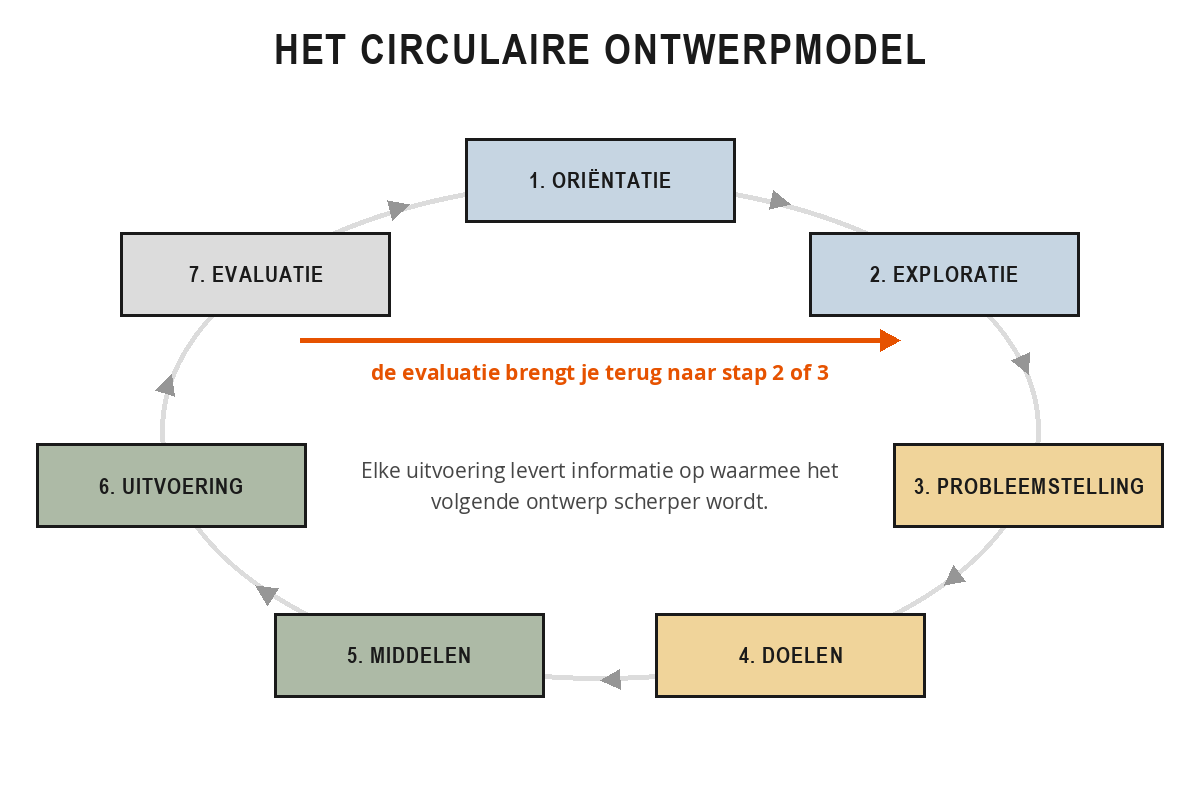
You start with the orientation: who is asking the question, and why now? Do you work for the open market, where you devise your own offering, or on behalf of someone within an organisation? That determines how much freedom you have. Next comes the exploration: you dive into the topic and gather material, examples and perspectives. In the problem statement you establish which gap you are going to close; that is the pivot of your entire design. From that gap follow the objectives, and only then do you choose the means: theory, practice, discussion, film, role play. Then comes the execution, and finally the evaluation.
What sets this model apart from an ordinary step-by-step plan is the return arrow. After the evaluation you are not finished, but jump back to the exploration or to the problem statement. If the group turned out to have far more prior knowledge, your exploration was wrong. If people kept getting stuck on attitude while you had focused on skills, your problem statement was wrong. In this way every delivery becomes the first step of your next design, and the third run of a course is nearly always stronger than the first.
Four sources in the exploration
The exploration phase is the phase that experienced professionals skip most readily, precisely because they already know the subject. That is where the risk lies: your own knowledge is one source out of four. The second is the conversation with people who do the work every day; half an hour often yields more than ten articles, and you immediately hear the language your participants use themselves. The third is literature and models, above all as a structure that participants can use to order their own practice. The fourth is the layperson's perspective: you explain the subject to someone who knows nothing about it. Where that person loses the thread is where your jargon sits, or a step you unconsciously skip. Beginning participants will get stuck at that same point.
Six themes in the intake interview
The intake meeting is the conversation in which you clarify the assignment with the person requesting the course. You're not there to sell your offering, but to find out what problem lies beneath it. Six themes keep that conversation complete. The reason: why is this request coming now, and what preceded it? The topic: broad coverage, or depth on a single point? The objective: what does the client want to see change, probed until you can translate it into behaviour? The target group: how many people, with what background, and are they attending voluntarily? The place: which room, and which resources? And the time: when, how long, and at what time of day?
A team leader asks for a course in presenting for eight staff members. When you explore the reason, it turns out that two people botched a client presentation last quarter and that the board is watching closely. When you explore the objective, it turns out to be about one moment: the quarterly update for clients, four times a year, always the same set-up. When you explore the time, it turns out one morning is available. Without those three answers, the trainer would have designed a broad two-day course that nobody can buy. With those answers, it becomes a morning in which all eight practise their own quarterly update twice.
The gap in three directions: knowing, doing and believing
After the exploration you have more material than will fit into a course. The problem statement is the filter that brings order to it: one or two sentences stating the difference between what participants do now and what they need to be able to do afterwards. A subject is not that. "Communication" is a subject; "service desk staff cannot turn a complaint into a solution" is a problem statement.
A workable problem statement splits that gap into three directions, because each direction calls for a different kind of learning activity. Knowing is the knowledge that is missing: facts, concepts, steps in a procedure. That is the part you transfer fastest, and precisely for that reason designers pile on too much of it. Being able is the behaviour participants must master later on; that calls for practice, repetition and feedback, and therefore takes up far more programme time. Believing is the attitude or conviction underneath it. As long as an employee believes that a complaining customer has only themselves to blame, technique will have little effect.
Put the three side by side on paper and you see straight away where the emphasis lies. If it lies with believing, you need room for discussion, reflection and personal experience. If it lies with doing, you reserve the largest part of your time for practice.
Nadia is a training adviser at a housing association. Her director asks for a course on giving feedback for fourteen team leaders, because the last employee survey showed that people do not feel they are held to account for their behaviour. During her exploration Nadia rings five team leaders. Four of the five describe the same situation: they see something that is not right, think "I'll wait for the next meeting", and then the moment has passed. Phrasing turns out not to be the problem.
Her problem statement becomes: knowing – team leaders do not know how to raise something without it turning into a judgement; doing – they don't have the conversation within a week of what they saw; believing – they feel you shouldn't bother a colleague with small matters. The emphasis lies on thinking and being able, not on knowing. That means: little theory, plenty of practice, and first room for the belief that lies underneath.
Three signals that you are still too broad
Your problem statement is not yet sharp enough if it fits every organisation in the sector, if you can no longer cross off a single topic because everything seems relevant, or if you cannot say what participants will do differently on Monday morning after the course. If you recognise one of these three, another conversation is needed.
There is another distinction you want to hear in the intake: does the client want to inform or to persuade? Sentences such as "they simply need to know how the system works" point to missing knowledge. Sentences such as "they really need to start seeing that" or "there is still some resistance" betray that an attitude has to shift, however businesslike the request sounds. Most assignments are a mixture, so the question is not whether, but in what proportion and in what order. If you start with explanation while the group rejects the reason behind it, nobody listens to the explanation.
Summarise the six themes in your own words at the end of the conversation and email that summary afterwards. That way you check whether you have understood it correctly, and you have a document to refer back to if the request shifts along the way. Also put your problem statement back to your client before you start programming. That conversation almost always yields new information, and it prevents you from building a course on an assumption.
Take the training request you have chosen for this course and work out the first three steps of the model.
- Orientation: who is asking the question, and why now? Two lines is enough.
- Exploration: note down one action per source (your own experience, a conversation, literature, the layperson's perspective) that you can take this week.
- Problem statement: write down three sentences, one for knowing, one for doing and one for believing.
- Put those three sentences next to your client's original question. What stands out about the difference?
Then go through the three signals. If your problem statement fits every organisation in the sector, you are still missing information. Note down what is missing, and who you can get it from.
Summary
- The request you receive is usually already a solution. Your work begins with what the client has seen happen.
- The circular design model runs from orientation via exploration, problem statement, objectives and means to execution and evaluation, and then back to step 2 or 3.
- In the exploration you use four sources: your own experience, conversations with those involved, literature and the layperson's perspective.
- An intake meeting covers six themes: reason, topic, objective, target group, place and time.
- The problem statement describes the gap in knowing, doing and believing. Where the emphasis lies determines what your programme looks like.
- You're still too broad if your problem statement fits any organisation, if you can't cut anything, or if you can't describe Monday morning.
Once the gap is on paper, the next question is how to make it measurable. That is chapter 2.
What distinguishes the circular design model from an ordinary step-by-step plan?
Nadia hears from four of the five team leaders that they put off the conversation until the moment has passed. In which direction of her problem statement does that mainly belong?
Which of these four is a problem statement and not a topic?