


1. Who you are writing for
Two reports on the same month, with the same figures from the same system, can turn out entirely differently. One leads to a decision, the other disappears into a folder. The difference lies not in the administration, but in five properties that you can check one by one.
After this chapter:
- You name the five criteria by which you assess the effectiveness of a report.
- Determine for each reader role which information that person needs and which they do not.
- You know why higher up in the organisation there is a need for less detail and more interpretation.
- You use the yardstick to test whether a passage prompts a decision or only a question.
- You recognise the phrasing that makes a report non-committal.
The five effectiveness criteria
Effectiveness criteria are the fixed standards by which you assess a report, regardless of who produced it and how polished it looks. They work like a checklist: you run through them and score each point.
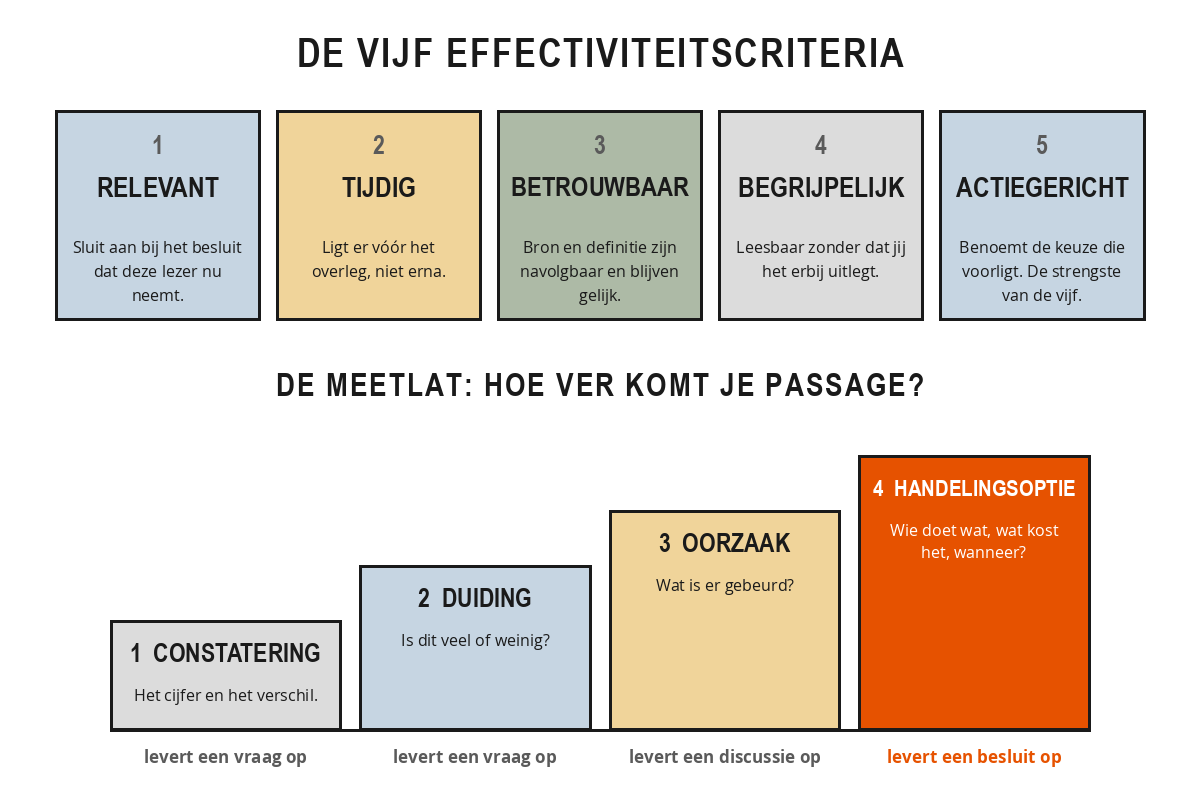
Relevant. The content ties in with the decisions the recipient is taking this period. A cost category that nobody can influence does not belong in a management report. For every line you can ask yourself who it is there for. If you cannot name a role, the line can go.
Timely. The report is available before the moment the decision is taken. A report that is perfectly accurate but appears two days after the meeting has an effectiveness of zero. Eighty per cent on day three is worth more than a hundred per cent on day fourteen.
Reliable. Source, definition and calculation are traceable and remain the same across periods. One figure that turns out to be wrong costs you confidence in all the other figures, including the ones that are correct.
Understandable. The reader understands the table or the chart without you sitting next to them to explain it. Jargon, internal codes and abbreviations that only exist in the back office undermine this criterion.
Action-oriented. The report states what is the case, what that means and which choice is on the table. This is the strictest of the five, and at the same time the most useful, because you can hold every passage up against it.
Information needs differ by role
Your reader's information need is the answer to one question: which decision does this person have to take shortly, and what data do they need at a minimum to take it? Anything that does not contribute to that is ballast. That need differs by role, and the difference is greater than most reports reflect.
A logistics team leader manages next week's staffing. They need figures per day, and they want them quickly; they can interpret them themselves, because they are in the thick of it. A member of the management team manages the annual result and wants to know where the deviation comes from and whether there is still scope to adjust. The board looks beyond the financial year and is content with seven key figures and a trend line, provided a judgement is attached. The higher up the organisation, the less detail and the more interpretation. If all three receive the same twelve pages, nobody reads them in full.
This is how you map out that need. First name the recipients by name and role: not "the management team", but the four people who actually open the document. Then find out which decision each of them takes, and simply ask the question out loud: "what do you use this page for?" The answer is usually shorter than you expect. Next, determine the level of detail that matches that decision; a decision about hiring calls for hours and rates, a decision about an investment for a multi-year picture. And finally, delete whatever does not support a decision. A table that is only there because it was there last year as well can go.
Ilse is a controller at an installation company with four branches. Every month she sent the same eighteen-page report to the branch managers and to the board. After speaking to the recipients, it turned out that the branch managers only looked at their own two pages and that the board only read the summary figures. Nobody read the rest, and hadn't done so for fourteen months.
She split the report in two: three pages per branch, with staffing levels and the margin per project, and a two-page board overview with eight key figures and an assessment. The discussion in the management team then took half an hour instead of an hour, and Ilse spent a day less per month on compiling it.
You test your assumption with one question to the recipient: "if I leave out this appendix next month, will you miss it?" Any hesitation tells you enough. Then actually leave it out once and see whether anyone asks about it.
The yardstick: how far does your passage get?
Action orientation is the extent to which your report enables the reader to take a decision within the meeting. You measure it per passage, along four levels.
At level 1 is the observation: the figure and the variance, nothing more. At level 2 comes the interpretation: is this a lot or a little, is it heading in the right direction? At level 3 comes the cause: what actually happened to make the figure come out this way? Only at level 4 there is a course of action: who does what, what does it cost or yield, and when will the effect be visible?
The yardstick works like this. A passage that gets no further than level 1 or 2 prompts a question during the meeting. A passage at level 3 prompts a discussion. Only level 4 leads to a decision. Not every paragraph has to reach level 4, but every variance that matters financially does.
Level 1: "Staff costs amount to 1,439,000 euros, an overrun of 6.2 per cent against budget."
Level 4: "Staff costs are 84,000 euros (6.2 per cent) over budget. The cause is the hiring of contractors for two vacancies that have been open since April, at an hourly rate 40 per cent above the internal rate. If policy remains unchanged, this will rise to roughly 150,000 euros over the year. Proposal: HR ends the contract hire at one location as of 1 November and converts that vacancy into a secondment contract. Decision requested in this meeting, effect visible in the December report."
The figure is the same in both sentences. In the first, the reader asks "why is that?"; in the second, they say yes or no.
The phrasing matters. "Under investigation", "requires attention" and "needs monitoring" are not courses of action; they are ways of avoiding a judgement. A course of action states who does something, what it costs or yields and when the effect will become visible. If you do not know the cause, write that down along with the date on which you will provide the answer. That is more honest, and it immediately produces a follow-up point.
Take the last report you produced or received.
- Score it on each of the five criteria, from 1 (weak) to 5 (strong), and note in one sentence per criterion why you give that score.
- Name the recipients individually and write behind each name which decision that person takes.
- Single out the three largest deviations and assign each a level from 1 to 4.
- Rewrite one of them to level 4, including cause, choice, amount and timescale.
Present your rewritten version to the recipient and ask whether they would be prepared to take a decision on it. If they say no, ask what is still missing.
Summary
- Five criteria determine whether a report works: relevant, timely, reliable, understandable and action-oriented.
- Timely beats complete. An accurate report that arrives after the decision is useless.
- Information needs differ by role: the higher up in the organisation, the less detail and the more interpretation.
- Name your readers individually, establish which decision each of them takes and delete whatever does not support a decision.
- The yardstick has four levels: observation, interpretation, cause, course of action. Only level 4 leads to a decision.
- A course of action states who, what it costs or yields, and when the effect will be visible.
The monthly report is accurate to the last decimal, but is routinely published two days after the management team meeting. Which criterion is at stake here?
What does this chapter say about the difference between a team leader and the board as a reader?
Your commentary states: "Contractor costs are substantially over budget due to the open vacancies; this requires attention." Which level of the yardstick does this passage sit at?