


Introduction
A candidate talks fluently and convincingly about working in a team. Afterwards you have had a pleasant conversation, you have a good feeling, and yet you don't really know what this person actually did. Two months later it turns out he does something quite different in your team from what he described. That is precisely the problem the STAR method answers.
Selection is about prediction. You want to know how someone will behave in your organisation, and the best predictor of that is past behaviour. You will only get that behaviour out into the open if you ask specifically about real situations: what was going on, what was the candidate's task, what did he do himself and what came of it. Without that structure you fill in the gaps with your own assumptions, and then you are selecting on gut feeling instead of on facts.
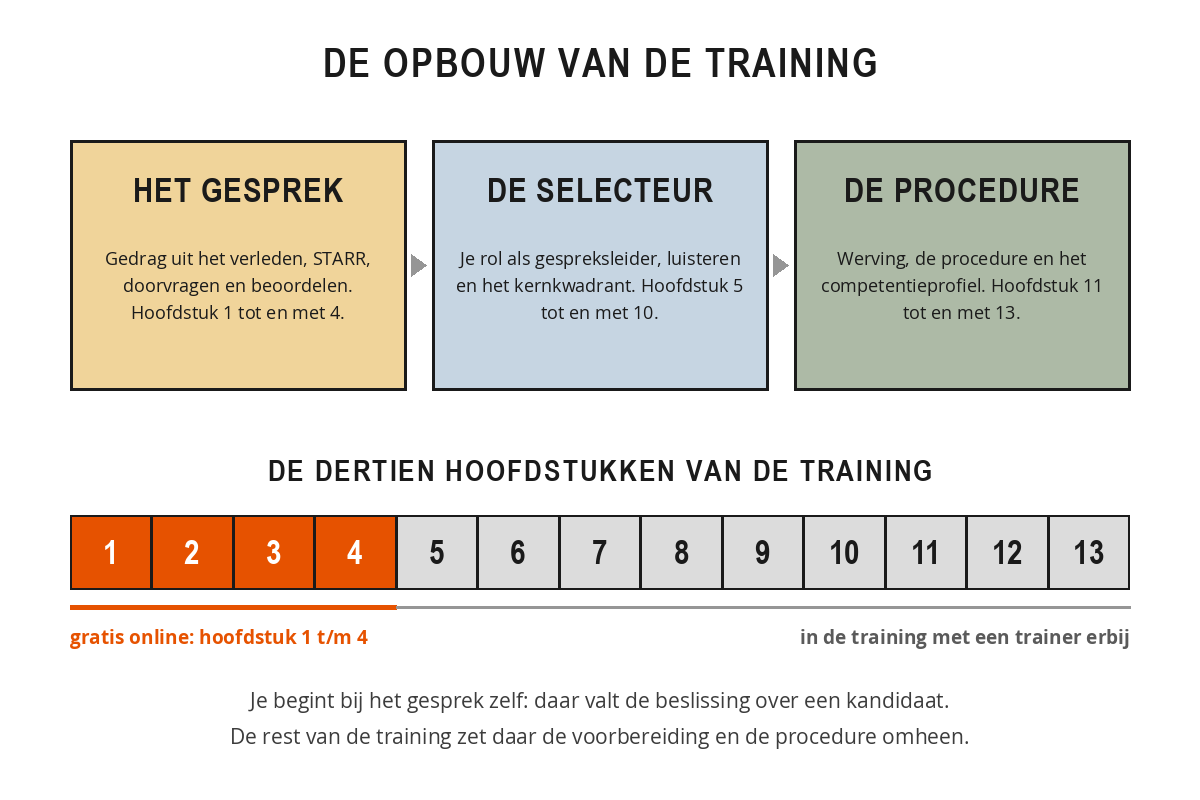
This free course contains the first four chapters: the orange part of the bar above. At the bottom of chapter 4 you will find the full course.
What you will learn
You will learn why a question about the past yields more than a question about good intentions, and how to hear the difference between an example of behaviour and an opinion. You will then be given the STARR model: situation, task, action, result and reflection, with the questions that belong to each step. You will practise probing until you hear an action with a date and a person involved, and you will finish with assessment: scoring with evidence, weighing with minimum thresholds and the thinking errors every selector makes. The common thread: you gather during the interview, and only judge afterwards.
How the course is structured
The course consists of three parts that build on one another. The first part covers the conversation: past behaviour, the STARR model, probing and assessment. Those are the four chapters you can read here free of charge, and that is where the decision about a candidate is made. The second part covers the selector: your role as interviewer, communicating, active listening, leading the conversation and Ofman's core quadrant. The third part covers the procedure: preparing the recruitment, the application procedure and the competency profile you assess against. Each chapter contains theory, a model, examples from practice and an exercise you apply to your own vacancy.
Practical tips for use
- Keep a vacancy or job profile to hand that you will be working with soon. The exercises only pay off if you complete them for a real position.
- Don't read it all in one go. One chapter a week, with an interview in between to try it out, sticks better.
- Write out your questions in advance and take them with you on paper. Formulating a sharp question on the spot rarely works, because your attention is on the answer.
- Ask a colleague to sit in on your next selection interview and tell you afterwards what he heard you do.
- Start small. Really exploring one competency with STAR yields more than covering six competencies halfway.
Each chapter ends with a short knowledge check of three questions: answer them correctly to mark the chapter as completed. Your progress is saved automatically in your browser.
Enjoy the reading, and above all: good luck with your next candidate.