


2. Demonstrating and letting them do it
Explaining feels productive. Something is happening, the group is watching, you are busy and you get through your material. Silence while twelve people sit typing feels empty, as if you are doing nothing. Yet that silence is precisely the moment when the learning happens. This chapter is about the ratio between your speaking time and their doing time, and about the sum you can apply to your own session plan.
After this chapter:
- You name the six layers of Bales' learning pyramid together with the percentage that goes with each.
- You work out for your own programme how many minutes fall into the bottom two layers.
- You rebuild a block into short cycles of explanation and practice.
- You give a demonstration that can be followed, and you know why you don't make it too long.
- You plan repetition deliberately, spread out and in varying formats.
Six layers of processing
The learning pyramid is named after Robert Bales and shows how much of the material is still recallable after about two weeks, depending on how the participant has processed it. The passive formats are at the top, the active ones at the bottom. The percentages are not precise measurements, but the ranking is stable and that is enough to work with.
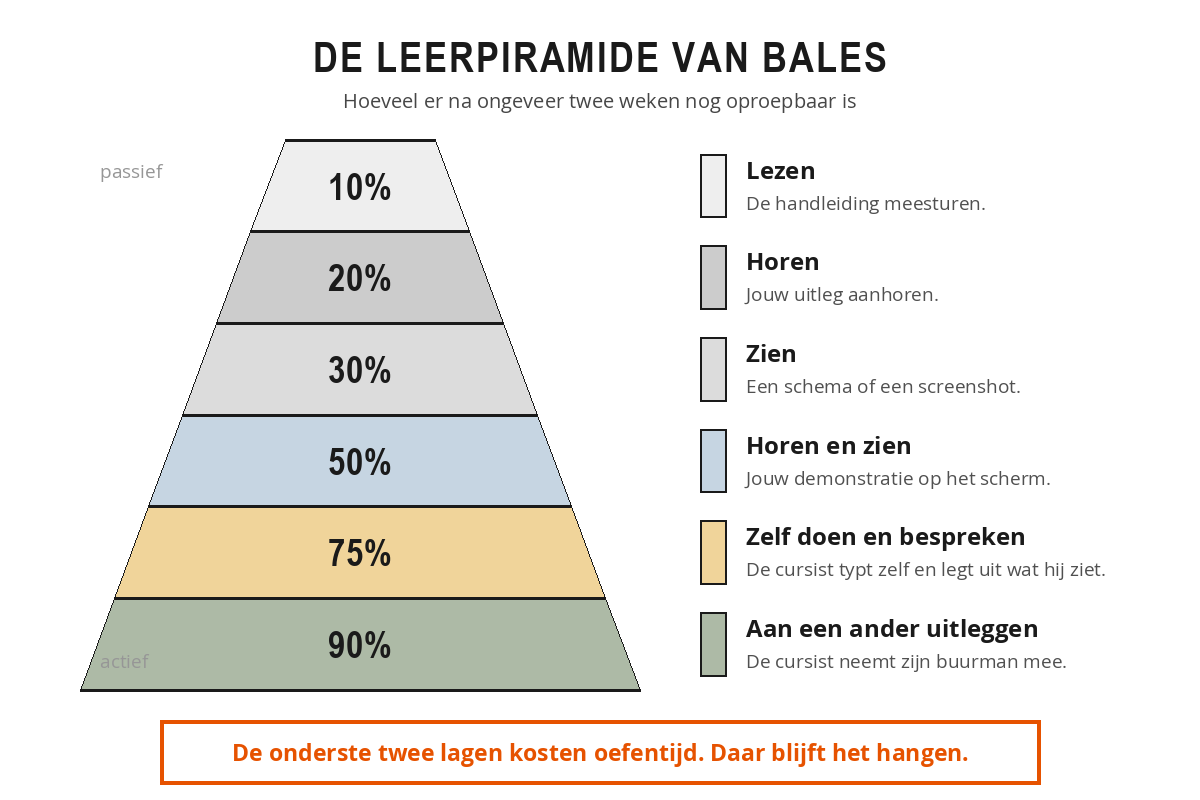
From top to bottom: reading yields around ten per cent, so sending along the manual amounts to almost nothing. Hearing comes to twenty per cent, and that is your explanation. Seeing reaches thirty per cent; think of a diagram or a screenshot. Hearing and seeing together, in other words your demonstration on the screen, comes to fifty per cent. Below that it starts to get interesting: doing it themselves and discussing it is around seventy-five per cent, and explaining to someone else at ninety per cent.
For a technical course that order is awkward. The formats you reach for most easily as a subject expert are all in the top half. Sending along a manual is reading. Giving a good explanation is hearing. Showing an architecture diagram is seeing. Even the demonstration you spent an hour on gets no further than halfway. Only when the participant types it themselves, makes the mistake themselves and fixes it themselves are you in the bottom two layers.
The calculation on your session plan
You put the pyramid next to your session plan and count the minutes per activity type. How many minutes are you talking or clicking, and how many minutes are they doing something themselves? Many technical courses come out at roughly seventy per cent transmitting and thirty per cent doing, while the result calls for the reverse ratio.
Take a thirty-minute block with twenty minutes of demonstration and ten minutes of practice. Turn that around: eight minutes showing, two minutes jointly naming what happened, twenty minutes having them do it themselves. Same block, same content, different result. And you do not have to ask for extra time; you only shift where the minutes go.
Jeroen runs an afternoon on a new ticketing system: three hours, twelve participants from the service desk. In his first outline he gives a forty-minute tour of all the screens, followed by an exercise in which everyone creates and resolves five tickets. In practice, half the group gets stuck on the first ticket, because they can no longer recall the category structure from forty minutes ago. He spends the last forty minutes putting out fires.
In his revised set-up he talks for eight minutes about creating a ticket and then has everyone create one ticket. Seven minutes on categorising and assigning, then categorising three tickets. Six minutes on handling and closing, then finishing the tickets off. His speaking time drops from forty to twenty-one minutes, on the same afternoon, and all twelve participants end up with five handled tickets.
Working in short cycles
Less explanation is not automatically better. An exercise without any prior explanation mainly produces guesswork, and a demonstration that goes too fast produces actions no one can repeat. What does work is alternating in short cycles: you explain a clearly defined piece, have it done straight away, and only then move on.
In technical courses, the workable unit is between five and ten minutes of explanation, followed by ten to fifteen minutes of doing it yourself. If you consistently go beyond that, the first half of your explanation has already faded before the exercise begins. Cycles also give you four opportunities an hour to see what is going wrong instead of one. If someone is stuck on step two, you notice after ten minutes rather than after forty. That saves repair time, and it saves the participant the feeling that they are the only one falling behind.
For every hands-on exercise, agree on what tells you at a glance that it has worked. The account is in the list. The ticket has the status 'resolved'. The query returns four rows. A visible outcome like that makes walking around easy: you don't have to ask whether it's working, you can see it on the screen.
A demonstration that can be followed
The demonstration is the hinge between your explanation and their practice, and it is where most of the time leaks away. Four things make the difference. You announce first what you are going to do and what it leads to, so the group knows what it is looking at. You do it at the speed someone can write it down, not at the speed you would do it yourself. You say out loud with every click what you are pointing at and why, because without words twelve people see twelve different things. And you do it once all the way through and only then again with pauses, rather than the other way round.
Two habits will cost you the group. The first is talking to your own screen: your words disappear into the monitor and you don't notice that three people have dropped out. The second is showing something else during your demonstration, just because it happens to come up. That one detour doubles the number of steps the group has to remember.
During your demonstration, ask the group to keep their hands off the keyboard and tell them there will be time afterwards to do it themselves. Typing along during a demo sounds efficient, but it leaves you with twelve people who are lagging behind and hear nothing of your explanation. First watch, then do.
Repetition that sticks
Explaining something once is not learning, it is offering. What you practise today fades within a few days if nothing more is done with it. Repetition slows that decline, but only if done the right way: spaced rather than stacked, and retrieving rather than offering again. Three times ten minutes spread over a day yields more than thirty minutes in one go. And a participant who names the steps from memory strengthens their memory trace, while someone who hears you list the steps only recognises what they hear.
Three formats that take little time. Retrieval questions at the start of a block: you start a new section with two questions about the previous one. Not as a test, but as a warm-up: who can say from memory where you set the permissions? Variation in format: what you demonstrated first, you later have them write down as a step-by-step plan and later still explain to a neighbour who does not get it yet. Each format lays down a different trace, and that last one is also the bottom layer of the pyramid. Repetition after the course: a short assignment that the participant carries out at their own workplace within a week, with a crib sheet to go with it. Without that anchoring, everything you built up on the training day depends on chance.
Sanne is training fourteen engineers on a new app for job sheets. She chooses three core actions in advance that absolutely have to stick: opening a job sheet, entering hours and materials, and signing the sheet off. Each action comes back three times, in three formats. In the morning she demonstrates it and they practise it. After lunch they write down the steps on a card in pairs, from memory. At the end of the afternoon everyone explains one of the three actions to the person next to them. Four weeks later, the helpdesk reports show that no one has called about those three actions; the questions that do come in are all about the fourth topic, which she only showed once that day.
Take the session plan for a session you recently gave or are about to give and count the minutes per activity type.
- Total teaching time in minutes.
- Minutes of reading, hearing and seeing, so the top three layers.
- Minutes of demonstration, the hearing and seeing layer.
- Minutes spent doing, discussing or explaining to each other, the bottom two layers.
- The percentage that falls into those bottom two layers.
Then pick the block where the ratio is most lopsided and cut it into three cycles of at most eight minutes of explanation followed by a hands-on task. For each task, write down how you can tell at a glance that it has worked. Finally, note which two or three key actions need to come back three times, and in which three formats.
Summary
- The learning pyramid runs from reading (10%), hearing (20%) and seeing (30%) via hearing and seeing (50%) to doing and discussing (75%) and explaining to someone else (90%).
- The formats a subject expert reaches for first are all in the top half; even your demonstration gets no further than halfway.
- Count the minutes in your session plan. Many technical courses sit at seventy per cent transmitting while the result calls for the opposite.
- Work in cycles of five to ten minutes of explanation with ten to fifteen minutes of doing it themselves, and agree for each task how you can tell it has worked.
- You give a demo at the speed someone can write it down, saying out loud what you are pointing at, with the group's hands off the keyboard.
- Repeat in a spread-out way and in varying formats, let the participant retrieve the material themselves, and give them a short assignment for their own workplace.
Which layer of the learning pyramid does a demonstration sit on, where you show how it is done and the group watches and listens?
You have a thirty-minute block with twenty minutes of demonstration and ten minutes of practice. What does this chapter propose?
Why does retrieving work better than offering again?