


Introduction
Someone who knows a great deal about a subject is not yet a trainer. You notice that difference the moment you stand in front of a group and twelve pairs of eyes look at you enquiringly. Your knowledge is not the problem. The question is how to present that knowledge in such a way that people actually do something with it.
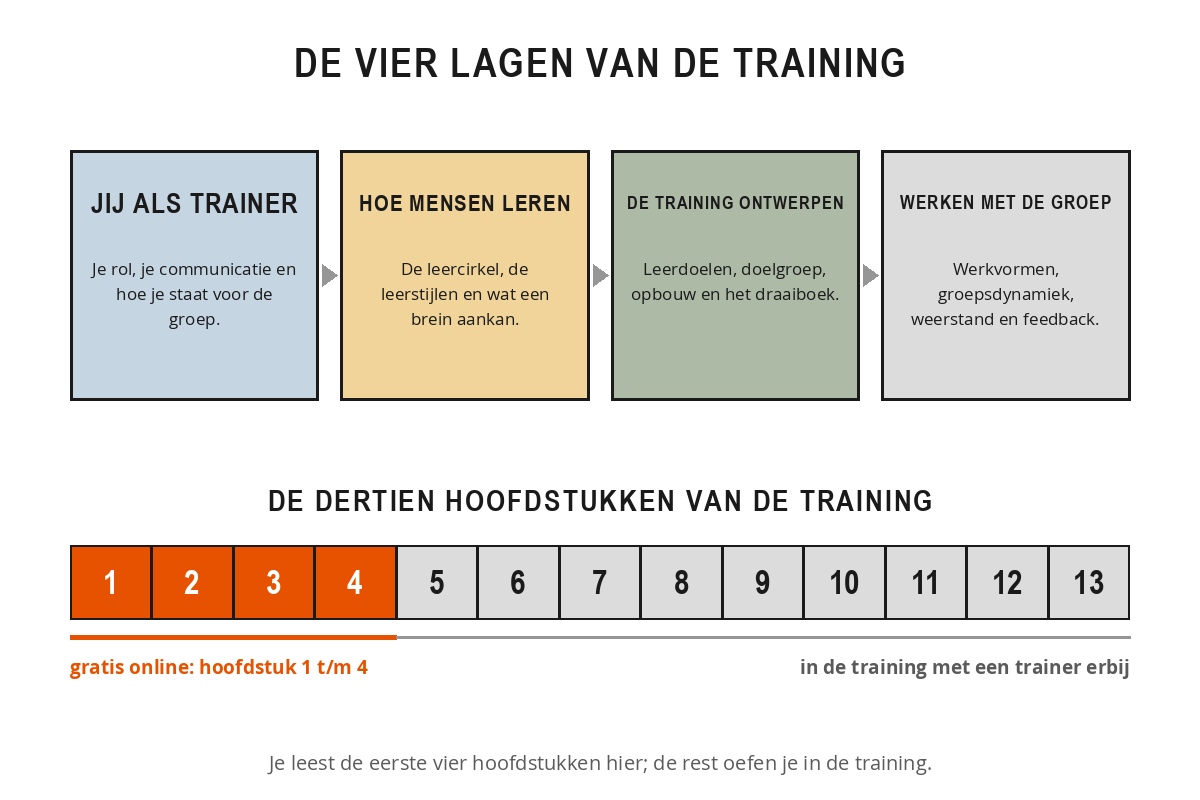
This free course consists of four chapters: the orange part of the bar above. At the bottom of chapter 4 you will find the full course.
What you will learn
You start with yourself: how you stand, look and sound in front of a group, and what you do with the tension that comes with it. Then you turn to the other side of the room, because only once you know how people learn can you decide what to have them do. You are given Kolb's learning cycle and the four learning styles that follow from it. After that it becomes practical: which activity suits which aim, and how to present a proposition or a subgroup assignment so that it does what you want. The final chapter deals with what goes on beneath your programme: group phases, resistance and the question of how lightly you can intervene.
How the course is structured
The full course follows the path you actually take as a trainer, in four layers. First you as a trainer: your role, your communication and your delivery. Then how people learn: the learning circle, the learning styles and what a brain can handle. Then designing the course: learning objectives, target group, structure and running order. And finally working with the group: working formats, group dynamics and feedback. In this free course you read the core chapter from three of those four layers. The design work, in which you build a complete programme, is part of the course itself, because that is work you are better off not doing on your own.
Practical tips for use
- Pick one course that you will be giving soon and keep it to hand throughout. All the exercises fit that one programme.
- Keep a notepad or a blank document to hand. The exercises only work if you actually complete them.
- Don't read it all in one go. One chapter a week, with time to try something out, gets you further than reading through it in an afternoon.
- Try out one thing with the group for each chapter. Reading about grounding does nothing to change how you stand.
- Ask a colleague to sit in for ten minutes, or put your phone on a tripod at the back of the room. Seeing yourself on video teaches you more than ten evaluation forms.
Each chapter ends with a short knowledge check of three questions: answer them correctly to mark the chapter as completed. Your progress is saved automatically in your browser.
Enjoy the read, and above all: enjoy the next group sitting in front of you.