


1. Standing in front of the group
Before you have said a single word, the group already has an impression of you. That impression comes from your posture, your gaze and the tension in your shoulders. Participants usually cannot say why they believe one trainer and not another, but they sense it within half a minute. The good news is that this is not a talent you either have or do not have. Your body and your voice are instruments, and you can practise with them.
After this chapter:
- You deliberately set up your posture by grounding yourself, and you notice when you lose that posture.
- You distribute your eye contact so that everyone in the room experiences contact with you.
- You choose your position in the room on the basis of what you are asking of the group.
- Use your sentence melody, articulation, pace and silences purposefully.
- You recognise stage nerves in your body and turn them into energy for the group.
- Track down the thoughts that feed your tension, and replace them with more realistic ones.
Grounding: standing firmly without stiffening up
Grounding means standing in such a way that you make good contact with the floor and your weight is evenly distributed. It is the middle ground between slouching and tensing up. A hunched posture gives the group the feeling that the subject does not mean much to you either. A fixed, rigid posture conveys unease. Standing grounded gives you calm in your voice and your breathing, and the group takes that calm from you.
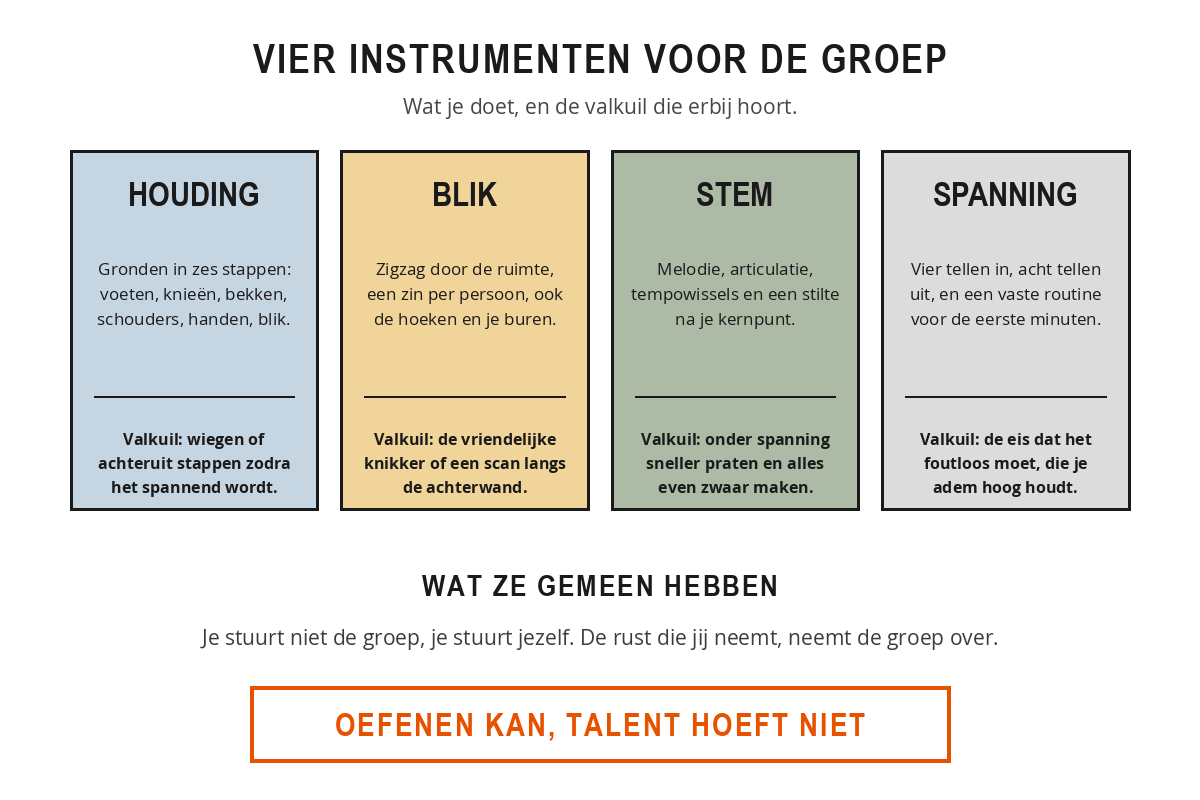
You build up that posture in six steps, just before you begin. You place both feet flat on the floor, roughly hip-width apart, with your weight on both legs. You let your knees bend a fraction, so they are not locked. You let your pelvis hang straight and your back lengthen, as if your crown were being gently drawn towards the ceiling. You raise your shoulders once and let them drop on the out-breath. You let your arms hang alongside your body or fold your hands loosely in front of your stomach, ready to gesture. And you look around the room and find one participant before you say your first sentence.
Grounding does not stop with your opening sentence. You lose your posture fastest the moment something unexpected happens: a difficult question, a participant sighing audibly, a projector that will not work. Your weight shifts onto one leg, you start rocking, or you step back towards the screen. Briefly returning to two feet on the floor is then the shortest route back to calm.
Spreading your gaze around the room
Eye contact is the way you let a participant know that your story is meant for him too. Without that contact his attention drifts away, however interesting your subject may be. Two pitfalls occur with almost every beginning trainer. The first is the friendly nodder: that one participant who moves along in agreement, so that your gaze keeps sliding in that direction. The second is scanning along the back wall, just above people's heads. To you that feels like looking at the group, but to the group it feels like not being seen.
What does work is a calm zigzag pattern. You make real contact with one person for a few seconds, about the length of a sentence, and then move to someone in another part of the room. That way everyone gets a turn without your gaze shooting back and forth like a tennis ball. Don't forget the corners and the people sitting right next to you, because they are the easiest to skip. If you are reading something out or looking at a slide, look up in between. After twenty seconds of talking to your screen you have lost the group.
Ruben is delivering a course on privacy rules for the third time, to a group of eleven people. During the first half hour a colleague keeps count of who gets eye contact. The result: seven of the eleven participants not once, and two people on the front row seventeen times between them. Ruben is taken aback, because he thought he was looking round the whole room. After the break he deliberately delivers three consecutive sentences to three different people, each time someone from a different part of the room. In the evaluation, two participants from the back row spontaneously mention that the second part felt "much more personal". Ruben had changed nothing about his content.
Gestures and the use of space
Gestures that support your story make it livelier: counting off three points on your fingers, drawing a rising line in the air, pointing with your hand at the flip chart you have just filled. It becomes distracting when it is repeated without meaning. Fiddling with a pen, constantly running your hand through your hair, playing with your glasses or nodding non-stop is distracting, and you usually do not notice it yourself. That is precisely why footage of your own performance is so valuable.
The room in which you train is not a backdrop but a tool. Where you stand says something about what is expected of the group. If you stand centrally at the front, you take the lead and attention is on you. If you step aside, to the edge of the circle, you give the space back to the participants. If you walk around during an exercise, you are available without claiming attention. A change of position is therefore a signal: the group reads from it whether the moment calls for listening or for working.
Two kinds of movement are almost always distracting. The first is shuffling back and forth to release tension. The second is talking with your back to the group while you write on the flip chart or search through your slides. Your words then disappear into the paper. Both can be solved with an agreement you make with yourself: you write in silence and only carry on speaking once you have turned round, and you only move deliberately, a few steps when a new topic begins. That way movement becomes a punctuation mark in your story rather than noise.
Your voice: melody, articulation, pace and silence
Your voice holds attention once the first impression has landed. You have four controls for this, and they can be operated independently. Sentence melody is the variation in pitch across your sentences. If you go up or down in the same way at the end of every sentence, your story sounds monotonous and attention drifts away, however good your content is. Articulation is the precision with which you form sounds. Slack articulation makes you hard to follow and takes the expression out of your face with it; anyone who articulates clearly automatically uses more facial expression.
Pace is more than the speed at which you finish. A key concept delivered more slowly and with a little more volume gains weight. An example or an anecdote may go faster, because there the group does not have to weigh every word. Under tension your pace creeps up without your noticing, and then the difference between the main point and the side issue disappears. The fourth control is silence. A breathing pause is the short stop in which you take air. A speaking pause is longer and has a didactic purpose: after a key point or a question you let a silence fall so that the group has time to think along. To you such a silence feels endless; to the group it is a moment of calm.
Els explains the four steps of giving feedback. At step 1 she says: "The first step is to describe what you have seen." She lets two seconds of silence fall and looks round the U-shape. Then, at a faster pace, comes an example from her own practice, about forty seconds long. At step 2 she again speaks more slowly and a little more weightily. Beforehand, she underlined one word in her session plan at each step that has to be slow. The group hears, without being told, where the key point lies and where the illustration begins, and in the debrief seven of the nine participants name all four steps from memory.
Turning performance tension into energy
Performance tension is the physical activation that occurs the moment you become visible to a group. Your heart rate goes up, your breathing becomes higher and faster, your mouth dries out and your attention narrows. That is not a defect, it is the energy that sharpens you. So the aim is not for the tension to disappear, but for you to be able to work with it.
Under pressure, your breathing shifts up into your upper ribs. Your breath becomes short, your voice climbs and your sentences get longer, because you no longer dare take a breath anywhere. Low breathing works exactly the other way round: your diaphragm drops, your belly comes forward and you have enough air for a whole sentence. Just before you start, this works: breathe in through your nose for four counts, breathe out for eight, and repeat three times. The long out-breath takes the peak out of your heart rate.
Tension is at its highest in the first two minutes, so that is where you give yourself something to hold on to with a fixed routine. You arrive early, set up the room, test your equipment and receive the first participants as a host. You ground yourself before you begin. You breathe out slowly three times. You open with something you know word for word: a welcome, the aim and the structure of the day, so that you do not have to improvise those first thirty seconds. And you quickly give the group something to do, because as soon as the participants are speaking, the peak subsides by itself.
The thought beneath the tension
Low breathing addresses the physical side. The fuel usually sits a layer deeper, in what you tell yourself about the group and about your own performance. The rational emotive method of psychologist Albert Ellis assumes that the way you think determines how you feel. Two participants are whispering at the back. One trainer thinks: "They don't like it, I've lost them." The other thinks: "Good, they're just exchanging what they have heard." The same observation, a different interpretation, and with it a completely different feeling about the group.
To track down such a thought, you take a specific situation through four steps. At event you describe as objectively as possible what happened: the explanation you gave, the question you were asked. Under thought you work out what you were saying to yourself at that moment, especially the unreasonable demands: I have to do it faultlessly, I mustn't go red, my story makes no sense at all. With feeling you name what those thoughts brought up: insecurity, powerlessness, anger. At behaviour you describe what you did at that moment and do not want to repeat: talking faster, waving questions away, avoiding eye contact.
Then you look for a more realistic variant. Not a cheerful slogan, but a thought you believe yourself. For example: if I make a mistake I am not a failure; I do not expect others to know all the answers either. The final question is what behaviour follows from that. Usually it is small and concrete: handing the question you cannot answer back to the group out loud, instead of talking around it.
Put your phone on a tripod at the back of the room and film the first ten minutes of your next course. You do not have to show it to anyone. Those ten minutes will tell you more about your posture, your gaze and your movements than ten evaluation forms, because a group rarely writes down what it actually saw.
Take a three-minute explanation you will be giving shortly and deliver it twice to two or three colleagues.
- Round 1: you stand the way you normally stand and pay attention only to the content.
- Round 2: you first build up the six steps of grounding, mark two key words in advance that need to be slow, and leave a three-second silence after your most important sentence.
- After each round, ask: how calm did I come across, and who received eye contact?
- Note down one difference the viewers saw and one difference you felt yourself.
Then work out one moment when you felt uncomfortable: what happened, what thought shot through your mind, what did that bring up, what did you do then, and which more realistic thought will help you do better next time?
Summary
- Grounding gives you a posture in which you look calm and breathe freely: feet, knees, pelvis, shoulders, hands, gaze.
- A calm zigzag pattern makes sure everyone gets eye contact; the friendly nodder and the scan along the back wall are the two pitfalls.
- Your position directs attention: standing centrally at the front you transmit, at the side you facilitate, walking around you are available.
- With sentence melody, articulation, changes of pace and pauses you hold the group's attention and make the key point audible.
- Stage nerves are usable energy: four counts in, eight counts out, and a fixed routine for the first few minutes.
- Underneath that tension are thoughts. Work through event, thought, feeling and behaviour, and replace the demand with something more realistic.
Halfway through your explanation you get a critical question and notice you are becoming unsettled. According to this chapter, what is the quickest route back to calm?
What is the difference between a breathing pause and a speaking pause?
Two participants are whispering at the back and you immediately think: they do not like it. What does the scheme of event, thought, feeling and behaviour show about this?