


1. What AI is and isn't good for
Most disappointments with AI stem not from the tool but from the task. Someone asks for something a language model cannot do by definition, receives a neatly worded answer that is wrong, and concludes that the whole thing amounts to nothing. Those who know where the boundary lies use AI for the work it is actually good at and keep the rest themselves. This chapter draws that boundary.
After this chapter:
- You can explain why a language model is strong on form and weak on facts.
- You recognise the five kinds of work AI is genuinely good at today.
- You recognise the five places where a language model systematically trips up.
- You can identify which of three roles you are giving the assistant at any given moment.
- You can use the intern rule of thumb to decide quickly whether to outsource a task.
What's under the bonnet
A language model is trained on enormous quantities of text and essentially does one thing: predict which word is likely to come next. That sounds simple, and it is. Everything an assistant does for you in the office comes out of that one trick, repeated very many times.
From that follows the most important characteristic straight away. A model is good at everything where "sounding likely" is the same as "being right". A friendly opening line for an email, a summary, a tidy structure: those are questions of form. As soon as "sounding likely" becomes something other than "being correct", things go wrong. An amount, a section of legislation, the name of a supplier: there, likelihood is not truth. The model has no way of noticing that it doesn't know something, so it fills the gap with something that looks good.
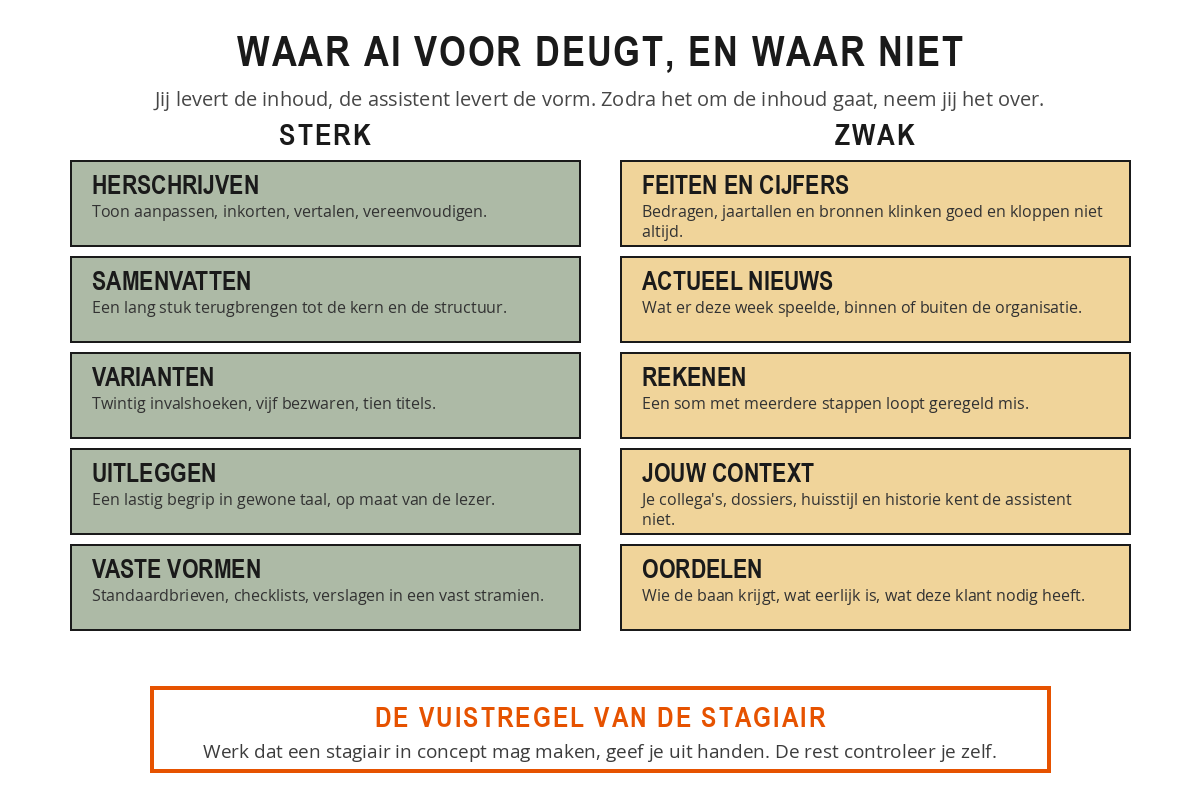
Five kinds of work AI is good for
Rewriting. Making a formal letter friendlier, shortening a long paragraph, translating a Dutch text into English, making a piece full of jargon understandable for a resident or a customer. The content is already there, only the form changes. This is the work AI is by far the strongest at.
Summarising. Reducing a twenty-page report to its essentials, a long email exchange to a list of decisions, an hour of meeting to ten points. The information is in the source you supply yourself, and that is exactly why it works well.
Coming up with variants. Twenty angles for a newsletter, five objections a customer might have, ten possible titles. A model doesn't get tired and isn't troubled by the feeling that it is already good enough. That is exactly what you are looking for when you are stuck.
Explaining. A difficult concept in plain language, a text tailored to a particular reader. Do bear in mind: the explanation is only as good as what was in the training material on the subject. For common subjects that is fine; for something that only goes by that name within your organisation it is not.
Fixed formats. Standard letters, checklists, job descriptions, reports in a fixed format. Work that is slightly different each time but follows the same form is ideal material.
Five places where it stumbles
Facts and figures. Amounts, years, article numbers and source references sound convincing and are not always correct. Anything you did not supply yourself and that matters, you check.
Current news. A model is trained up to a certain point in time. Whatever happened in the market or within your organisation last week is not in there, unless you supply it yourself.
Arithmetic. Adding up within running text often goes well and sometimes does not. A calculation with several steps, a percentage of a percentage, an allocation formula: that regularly goes wrong, and the error looks just as tidy as a correct answer.
Your context. The assistant does not know your colleagues, your files or your house style, and certainly not the history of that one difficult customer relationship. Everything specific to your work has to be supplied by you, every single time.
Judgements. Who gets the job, what is fair to this employee, what this client really needs: that is not text prediction. That remains human work, and not only because the model cannot do it. It is also the kind of decision for which someone has to be accountable.
Marloes works in the communications department of a housing association and has to write a letter to residents about a renovation. She pastes the technical project plan into the assistant and asks for a letter at B1 level. Within ten minutes there is a readable text that would otherwise have taken her half a day: rewriting and simplifying, exactly what the model is good for. But the third paragraph says the works will take "about six weeks". The project plan said eight. The model made that number up itself because it sounded right. Marloes takes it out and puts in the correct figure. The form was a gift, the figure was her work.
Three roles you give the assistant
If you look at how people use AI in the office, you broadly see three roles recurring. You sometimes switch between them within a single job, and it helps to know which one you are in.
As writing aid the assistant produces text or adapts text: emails, reports, announcements. You supply the substance and the context, it supplies the wording. If thinking partner it sharpens your ideas: it comes up with counterarguments, offers alternatives, asks the question you didn't ask yourself. Here the answer is not the product, the conversation is the product. If information processor it makes your source material manageable: it summarises, organises and extracts the action points. You supply the source, it supplies the overview.
The role determines how strictly you need to check. With the thinking partner, a half-good idea is still useful. With the information processor, what you mainly need to check is whether anything that mattered has been left out. With the writing aid, you watch the tone and any facts that have quietly crept in.
Before you start, ask yourself one question: am I supplying the content, or am I expecting it from the assistant? If you are expecting the content from the assistant, you are in the territory where things go wrong. In that case, supply the content yourself first, and let the assistant turn it into a form.
The intern rule of thumb
For most decisions you don't need a diagram, just one comparison. Imagine an enthusiastic intern sitting next to you. He is quick, writes neatly, is never grumpy and knows a surprising amount about all sorts of things. He doesn't know your organisation, he has no experience, and when he doesn't know something he won't say so but will make up something plausible.
Work you would happily let that intern draft, you outsource: rewriting, summarising, coming up with variants, drawing up an outline. Work you would not let them loose on without checking, you check yourself: figures, sources, sensitive conversations, decisions about people. And work you would not give them at all, you don't give the assistant either.
At an installation company of 40 people, work planner Hakim has the assistant summarise the week's quotation requests every Monday: customer name out, essentials in, three lines per request. That saves him a good hour a week. In the same week his manager asks him whether AI can also work out the distribution of hours across three projects. Hakim tries it: the assistant comes up with a distribution that adds up neatly to 100 per cent, but one of the three projects turns out to have been counted twice. He then does it in a spreadsheet, in five minutes, and only uses the assistant to write the explanatory note under the table. Outsource the summarising, do the sums yourself: the same tool, two different decisions.
Get out your diary from last week.
- Note down five tasks you have carried out that involved text or information.
- For each task, note whether it belongs on the left or the right of the diagram: is it a matter of form, or does it involve facts, context or a judgement?
- For the tasks listed on the left, decide which role you would give the assistant: writing aid, thinking partner or information processor.
- Pick one task to start with this week. Estimate beforehand how much time it currently costs you.
Keep your list. In chapter 4 you will use it when you make agreements with your team about what you will and will not use AI for.
Summary
- A language model predicts the next word. It is strong where sounding good is the same as being good, and weak as soon as those two diverge.
- Strong at: rewriting, summarising, coming up with variations, explaining and work in a fixed format.
- Weak at: facts and figures, current news, multi-step calculations, your own context and judgements about people.
- The assistant fulfils three roles: writing aid, thinking partner and information processor. The role determines how strictly you check the output.
- The intern rule of thumb: whatever you would let an intern draft, you outsource. The rest you check yourself.
- Ask yourself beforehand whether you are supplying the content. If not, you are in the territory where things go wrong.
Why does a language model sometimes invent a figure that is based on nothing?
You ask the assistant to come up with objections to a plan you have written. Which role are you giving it?
According to the intern rule of thumb, which task belongs on the weak side?