


3. Control with TGKIO
Time, money and quality are constantly pulling at each other in a project. Turn one dial and you feel it immediately in the other two. TGKIO makes that tension manageable, and it is one of the concepts that comes up most often in the exam: in the multiple-choice section as a question about the right aspect, in the case study as a question about the consequences of a change.
After this chapter:
- You know the five control aspects: time, money, quality, information and organisation.
- You understand why time, money and quality together form the devil's triangle.
- You can name, for each control aspect, what you plan, measure and adjust.
- You know the four steps of the control cycle and the pitfall it contains.
- You know how tolerances and escalation relate to your own room for manoeuvre.
The devil's triangle
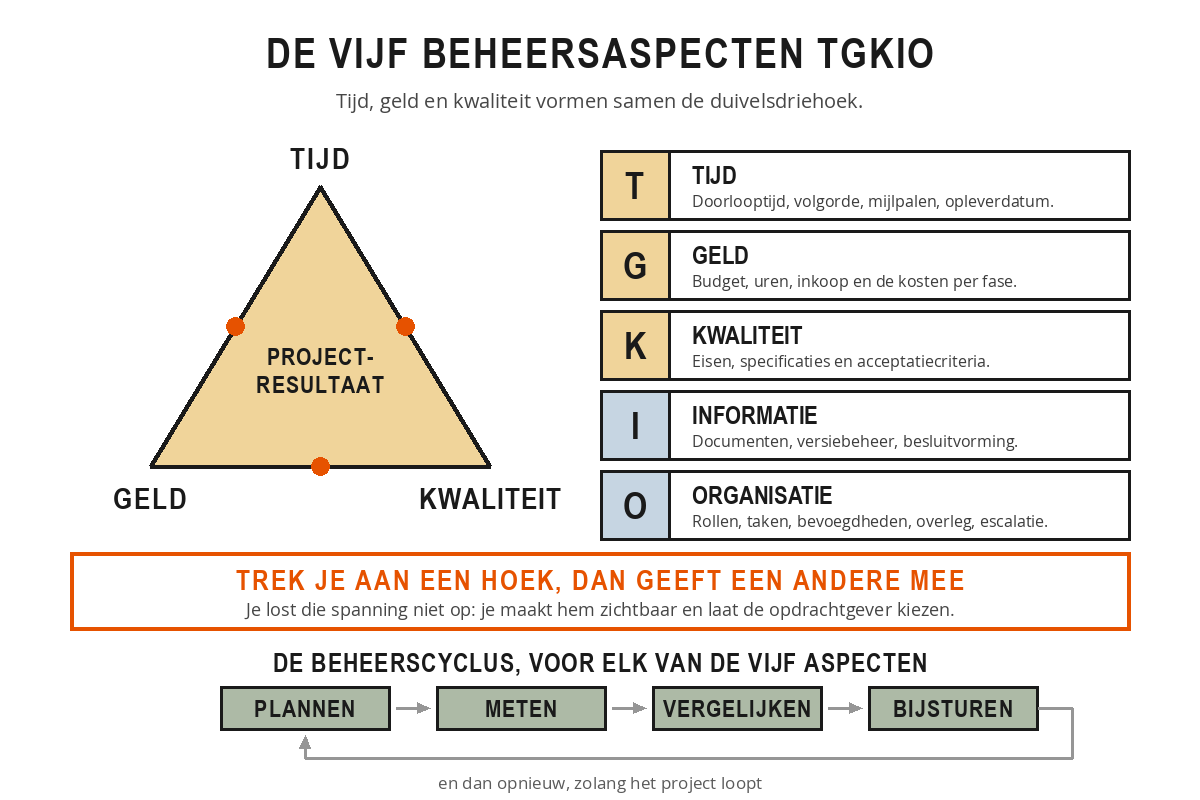
The three corners of time, money and quality are the hard preconditions of your assignment, and they are not separate from one another. You cannot improve one without the other two suffering. Hence the name: there is no setting in which all three are optimal at the same time.
If the client wants delivery two weeks earlier, you buy that time with extra people, and that is money, or you drop functionality, and that is quality. If the budget is cut, the lead time gets longer or the level of ambition goes down. If requirements are added, that costs time, money or both.
Your task is not to resolve this tension, because you can't. You make the tension visible and let the client choose. A request that pulls at one corner, you hand back together with the consequences for the other two.
The director asks Joost whether the new customer portal can go live three weeks earlier. Weak answer: "That's going to be difficult." Strong answer: "That's possible, but not without consequences. Option A: we drop the reporting module from this release and deliver it in phase two. Option B: we bring in two external developers, which costs 28,000 euros extra. Option C is to keep the current date. Which one do you choose?"
The choice now lies where it belongs, and all three corners have been named. That is exactly what an exam question on a case study wants to see from you: not that you say "no", but that you write out the consequences for each corner.
In the kick-off meeting you ask which corner is fixed for the client and which one offers room. With a statutory deadline, time is hard and you negotiate on scope. With a fixed budget, your room for manoeuvre lies in the delivery date. That answer determines how you deal with setbacks later on.
The five control aspects
Time, money and quality say something about what you deliver, but nothing about how the collaboration runs and who decides what. That is why project-based working has five control aspects, remembered together as TGKIO.
- T for Time: lead time, sequence of activities, milestones and the delivery date.
- G for Money: budget, hours, procurement, costs per phase and the monitoring of these.
- K for Quality: requirements, specifications and acceptance criteria of the project result.
- I for Information: documents, version control, decision-making and communication with stakeholders.
- O for Organisation: roles, tasks, authorities and the way you consult and escalate.
The first three together form the devil's triangle. The last two are the aspects most often forgotten in practice and most often the real problem in the case questions. A project in which nobody knows who may take a decision does not get stuck on technology but on O.
Control as a feedback loop
Control is not a one-off action at the start of a stage, but a cycle you keep completing for as long as the project runs. That control cycle works the same way for all five TGKIO aspects and consists of four steps.
Planning. You set down the standard: which date, which amount, which requirement, which meeting. Without a standard there is nothing to measure. Measure. You establish where reality stands: for time that is the progress per activity, for money the hours spent and the invoices, for quality the outcome of a test or review. Comparing. You place the norm and reality side by side and determine the deviation, and in doing so you also weigh up the expectation for the rest of the stage, not just what has happened so far. Adjusting course. You take a measure: distribute the work differently, adjust the scope, ask for extra capacity or have the norm formally changed by the client. And then you start again at planning.
The pitfall almost always lies in step two. Team members report progress in percentages, and those are unreliable. A task that is "90 per cent finished" often still requires days of work in practice. You get better information if you ask what has been completed and how much work remains, in hours or days.
You do not ask "how far along are you?" but "what is finished and how many hours do you still need?". The second question gives you a figure you can work with. The first gives you a feeling.
The frequency depends on the phase and the risk. In the delivery phase of a tightly planned project you measure weekly; in a quiet preparation phase, fortnightly may be enough.
Monitoring margins
A schedule that works out exactly on the day does not exist. That is why you work with margins: an agreed bandwidth within which you may adjust course yourself without asking permission. For each control aspect you set out how much deviation from the baseline plan is acceptable, and what happens when that limit comes into view. An agreement like this makes your role workable: you do not have to go to the steering group for every two-day shift, and the client knows for certain that he will hear in good time when things get serious.
Typical agreements look like this. With time: a milestone may slip by no more than two weeks, provided the project end date remains intact. In the case of money: the phase budget may be exceeded by no more than five per cent, up to a maximum of ten thousand euros. At quality: all must-have requirements are met; nice-to-have requirements may be adjusted after consultation with the user representative. With information: the progress report appears monthly, but if an overrun threatens, a notification follows within two working days outside that cycle. With organisation: you may reassign team members within the project yourself, but you may not hire in extra people from outside.
Margins mainly make the moment of escalation objective. Nobody has to weigh up whether something is "bad enough" to report: the limit is a number. That saves procrastination, because most project managers would rather report bad news a week later. A margin is not, incidentally, a reserve to be quietly used up. Anyone who consumes their room for manoeuvre in the first phase spends the rest of the project with their back against the wall.
Quality assurance in the project
Quality slips away as soon as time and money come under pressure, because it is the only corner you can quietly pull at. Everyone can see a late project; a half-tested system only becomes apparent after delivery.
Quality assurance is the whole set of agreements and measures with which you arrange in advance that the result meets the requirements. That is something other than checking at the end: assuring means that you set out in the plan who tests what, when that happens and who may say that it is good. The structure is always the same: requirements that have been recorded measurably in the definition and design phases, acceptance criteria by which the client can see that it is good, checkpoints such as reviews, tests, audits and inspections that appear as activities in the plan, assessors who make the judgement at each assessment moment, preferably someone who did not produce the item themselves, and recording in test reports, review records and signed approvals.
"The screen loads within two seconds" is testable. "The system is user-friendly" is not. In the exam, that difference is the difference between an answer that earns marks and an answer that just misses the mark.
In an implementation project for a new time registration system, one acceptance criterion was central: "twenty randomly chosen employees record their week correctly within five minutes without instruction". The project manager scheduled that test three weeks before go-live, not in the final week. The test showed that four of the twenty got stuck on the approval screen. There was still room to adjust it. Had the same test been scheduled in the final week, the choice would have been: postpone, or go live with a known problem.
Schedule test moments early enough for repair time to remain. A test that leaves no room for correction is not a quality measure but a formality.
Work out the control arrangements for one phase of a project you know or invent.
- Choose the phase and describe in one sentence which phase product is delivered at the end.
- For each TMQIO aspect, note down which standard you are setting and how you measure it.
- Set a margin for each aspect: how much deviation may you resolve yourself?
- Describe one escalation agreement: who hears what, and within how many days?
- Choose one acceptance criterion for the stage product and determine who tests it and when.
Summary
- The devil's triangle consists of time, money and quality. You cannot improve one without the other two giving way.
- You do not resolve that tension. You make it visible, with options and consequences, and let the client choose.
- TGKIO stands for time, money, quality, information and organisation. Information concerns documents, version control, decision-making and communication; organisation concerns roles, tasks, authority, meetings and escalation.
- The control cycle has four steps: plan, measure, compare and adjust. That cycle applies to each of the five aspects.
- The pitfall lies in measuring. Do not ask for a percentage but for what has been completed and how much work remains.
- Margins are the bandwidth within which you may adjust course yourself. They turn escalation into a number instead of a feeling.
- A margin is not a reserve to be quietly used up.
- Quality assurance sets out in advance who checks what, when and who passes judgement: requirements, acceptance criteria, review moments, assessors and recording.
- Schedule checkpoints early enough for there to be time left to put things right.
Your client wants delivery two weeks earlier. According to this chapter, what is the right response from a project manager?
In which step of the control cycle does this chapter say the pitfall almost always lies, and why?
What is the purpose of a margin, or tolerance, per control aspect?